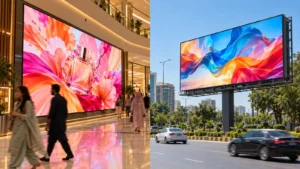

Key takeaways
- SMD screens in Pakistan are priced per square foot. Indoor screens start from Rs 15,500 per sq ft and outdoor screens start from Rs 10,000 per sq ft for the screen itself.
- The pixel pitch is the biggest price factor: a P1.5 indoor screen costs about Rs 40,000–64,000 per sq ft, while P4 costs about Rs 15,500–25,000 per sq ft.
- Steel structure and installation usually add 10–15%; GST is added on top.
- Use the free SMD screen price calculator for a tentative figure for your exact wall in 60 seconds.
Prices updated: October 2026. These are indicative ranges for budgeting. Your quotation will be exact.
In this guide
- SMD screen price per sq ft by pixel pitch
- How pixel pitch changes the price
- Indoor vs outdoor SMD screen price
- Example budgets for common sizes
- What else is in the quotation
- 8 things that change the price
- Running cost: electricity and maintenance
- How to pay less without regretting it
- How to get an accurate quotation
- FAQs
“How much does an SMD screen cost in Pakistan?” is the first question we hear from shop owners, marketing managers and event companies. The honest answer is “it depends on the pixel pitch, the size and whether it goes indoors or outdoors” – but you still need real numbers to plan a budget.
This guide gives DIGIX’s indicative 2026 rates per square foot for every pixel pitch we supply, shows what a 10 × 6 ft or a 20 × 10 ft screen actually costs, and explains what pushes the price up or down. The figures below come from the same price table that runs our SMD screen price calculator, so they stay current when our rates change.
1. SMD Screen Price per Sq Ft by Pixel Pitch
The table shows the screen price only – modules, power supplies, receiving cards and a media player – excluding steel structure, installation and GST. Click a pitch to see its full specifications, sizes and where it works best.
| Pixel pitch | Where | Price per sq ft (Rs) | Best for |
|---|---|---|---|
| P1.5 | Indoor | Rs 40,000–64,000 | Boardrooms, control rooms, studios – viewed from 1.5 m |
| P1.86 | Indoor | Rs 35,000–56,000 | Receptions, counters, corporate walls – from 2 m |
| P2 | Indoor | Rs 25,000–40,000 | Showrooms, shop interiors – from 2 m |
| P2.5 | Indoor | Rs 17,000–27,000 | Malls, shops, lobbies, restaurants – the popular all-rounder |
| P3 | Indoor | Rs 16,500–26,500 | Mall atriums, halls, large indoor walls – from 3 m |
| P4 | Indoor | Rs 15,500–25,000 | Auditoriums, high-mounted screens – from 4 m |
| P3.9 | Outdoor | Rs 20,000–32,000 | Events, stage screens, close outdoor viewing |
| P4 | Outdoor | Rs 19,000–30,500 | Shop fronts, entrances, petrol stations |
| P5 | Outdoor | Rs 15,000–24,000 | Shop fronts, plazas, medium billboards – 7,000+ nits, IP65 |
| P8 | Outdoor | Rs 12,000–19,000 | Roadside billboards, building façades – 7,500+ nits, IP65 |
| P10 | Outdoor | Rs 10,000–16,000 | Highway and rooftop billboards – the most economical pitch |
Fine-pitch P0.9 and P1.2 screens, and GOB and COB builds, are priced per project – ask us for a quotation. As a rule of thumb, GOB adds about 30% and COB about 60% to the SMD price for the same pitch; our SMD vs GOB vs COB vs LOB guide explains the difference.
Free toolGet the price for your own wallEnter your width, height and viewing distance – the calculator picks the right pixel pitch and shows size, resolution, power use and a tentative price.Try the free SMD planner2. How Pixel Pitch Changes the Price
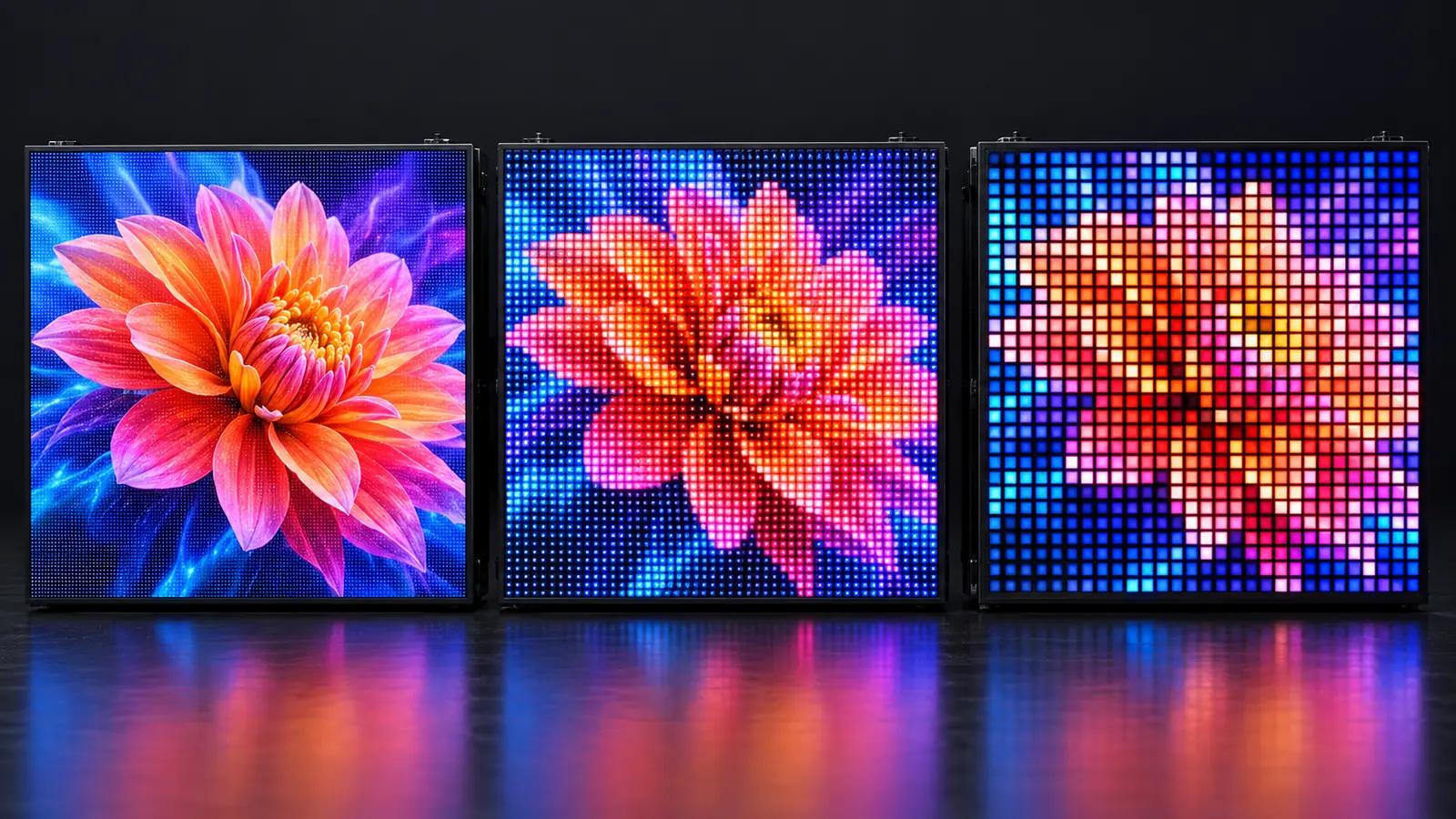
The pixel pitch is the distance between LEDs in millimetres. A smaller pitch packs more LEDs into every square foot – a P2.5 screen has 160,000 pixels per square metre, a P5 screen only 40,000 – so it costs more and looks sharper from closer.
The simple rule: the closest comfortable viewing distance in metres is about the pitch number. P2.5 looks sharp from about 2.5 m, P5 from about 5 m, P10 from about 10 m. Pick the largest pitch that still looks sharp from where your nearest viewers stand – that is where the savings are.
| Your situation | Usual pitch | Why |
|---|---|---|
| Boardroom, people sit at the table | P0.9 – P1.5 | Text and spreadsheets must stay readable from 1 m |
| Shop, lobby or mall corridor | P2 – P2.5 | Shoppers walk past 2–5 m away |
| Mall atrium, hall, stage backdrop | P3 – P4 | Viewers are 3 m or more away – P2.5 would be money wasted |
| Shop front, plaza, petrol station | P4 – P5 outdoor | Seen from the pavement and the road |
| Roadside or highway billboard | P8 – P10 outdoor | Seen from 8 m to 100 m, often from moving cars |
Compare every pitch side by side on our indoor SMD screens and outdoor SMD screens pages.
3. Indoor vs Outdoor SMD Screen Price
At the same pitch an outdoor screen is not simply “the indoor one in a box”. It needs:
- 5–7 times the brightness to stay readable in Pakistani sunlight – the DIGIX P5 and P8 outdoor modules deliver 7,000+ and 7,500+ nits versus about 1,200 nits for indoor P2.5;
- sealed modules and cabinets (IP65) against dust, heat and monsoon rain;
- a heavier steel structure, often with a pole, rooftop frame or façade mounting;
- more power, and sometimes permissions from the building owner or the city.
That is why the per-sq-ft rate for outdoor P4 (Rs 19,000–30,500 per sq ft) is higher than indoor P4 (Rs 15,500–25,000 per sq ft) – but outdoor screens are usually much larger and use coarser pitches (P8, P10), so the total cost per screen is often similar.
4. Example Budgets for Common Sizes
These examples use the rates above and add 10–15% for structure and installation. They exclude GST.
Shop or lobby: indoor P2.5, 10 ft × 6 ft (60 sq ft)
- Screen: 60 × Rs 17,000–27,000 = Rs 1,020,000 – 1,620,000
- Frame and installation (10–15%): about Rs 102,000 – 243,000
- Estimated total before GST: about Rs 1.12 – 1.86 million
Showroom wall: indoor P2, 12 ft × 7 ft (84 sq ft)
- Screen: 84 × Rs 25,000–40,000 = Rs 2,100,000 – 3,360,000
- Frame and installation (10–15%): about Rs 210,000 – 504,000
- Estimated total before GST: about Rs 2.31 – 3.86 million
Shop front: outdoor P5, 12 ft × 8 ft (96 sq ft)
- Screen: 96 × Rs 15,000–24,000 = Rs 1,440,000 – 2,304,000
- Structure and installation (10–15%): about Rs 144,000 – 346,000
- Estimated total before GST: about Rs 1.58 – 2.65 million
Roadside billboard: outdoor P8, 20 ft × 10 ft (200 sq ft)
- Screen: 200 × Rs 12,000–19,000 = Rs 2,400,000 – 3,800,000
- Structure and installation (10–15%): about Rs 240,000 – 570,000
- Estimated total before GST: about Rs 2.64 – 4.37 million
Highway billboard: outdoor P10, 40 ft × 20 ft (800 sq ft)
- Screen: 800 × Rs 10,000–16,000 = Rs 8,000,000 – 12,800,000
- Structure and installation (10–15%): about Rs 800,000 – 1,920,000
- Estimated total before GST: about Rs 8.8 – 14.72 million
Want your own size? The price calculator does this for any wall, and the 3D configurator lets you see the screen in your space and send a quote request in a few clicks.
5. What Else Is in the Quotation
A DIGIX quotation for an SMD screen is itemised, so you can compare it line by line with any other quote:
- LED modules or cabinets in your size and pitch.
- Power supplies and receiving cards.
- Control system: a media player for USB / Wi-Fi / 4G playback, or a video processor for live feeds. Usually Rs 25,000–150,000 depending on the screen.
- Steel structure, frame and finishing – about 10–15% of the screen price for normal walls; more for rooftops, poles and cranes.
- Installation, calibration and testing on site, in any city.
- Content management: the DIGIX CMS is free for the first year with DIGIX hardware, then from about Rs 2,000 per screen per year.
- Warranty: 1 to 5 years depending on the product. Check what the warranty covers – modules, power supplies and cards – not just “the screen”.
- GST, added to the total.
If a quotation is much cheaper than the others, check which of these it leaves out.
6. Eight Things That Change the Price
- Pixel pitch – the biggest factor, as shown above.
- Size – the price rises roughly in line with area, but a bigger screen gets a slightly better rate per sq ft.
- Indoor or outdoor – brightness, sealing and structure.
- Build: modules on a steel frame are cheaper; ready-made cabinets cost more but install faster and are easier to service.
- LED grade and refresh rate – 3,840 Hz and above gives smooth video and clean phone recordings; lower refresh rates are cheaper and flicker on camera.
- Technology: standard SMD is the base price; GOB adds about 30%, COB about 60%.
- Shape – curved, corner, column and custom shapes cost more than flat.
- Site and city – height, access, wall strength, power supply and distance from our nearest team. The dollar rate also moves prices, because the LEDs are imported.
7. Running Cost: Electricity and Maintenance
An indoor SMD screen uses about 130–160 W per square metre on average while showing normal content (outdoor screens use more, because they are brighter). A 60 sq ft indoor P2.5 screen running 12 hours a day uses roughly 250–350 units a month – about Rs 18,000–25,000 at Rs 70 per unit. The SMD power calculator works this out for your size.
The LEDs are rated for about 100,000 hours. Realistically, plan for a module or power supply replacement now and then after the warranty, and keep the screen’s brightness at what the room needs – running at 100% all day shortens LED life and raises the bill.
8. How to Pay Less Without Regretting It
- Do not over-specify the pitch. A P3 screen viewed from 5 m looks the same as P2.5 and costs noticeably less. Use the pixel pitch calculator.
- Size the screen to the wall and the viewing distance, not to the budget. A smaller sharp screen beats a bigger blurry one.
- Compare the total cost – screen, structure, installation, CMS, warranty and electricity – not only the per-sq-ft rate.
- Ask what brand of LEDs, power supplies and cards is quoted. DIGIX builds with components from trusted names such as Unilumin, BOE, Dahua, Novastar and Huidu.
- Be careful with very low quotes. They usually mean refurbished modules, low refresh rates, a thin structure or no real after-sales support.
- Buy once. A consumer TV or a cheap screen that fails in 18 months costs more than a proper SMD screen that runs for years.
9. How to Get an Accurate Quotation
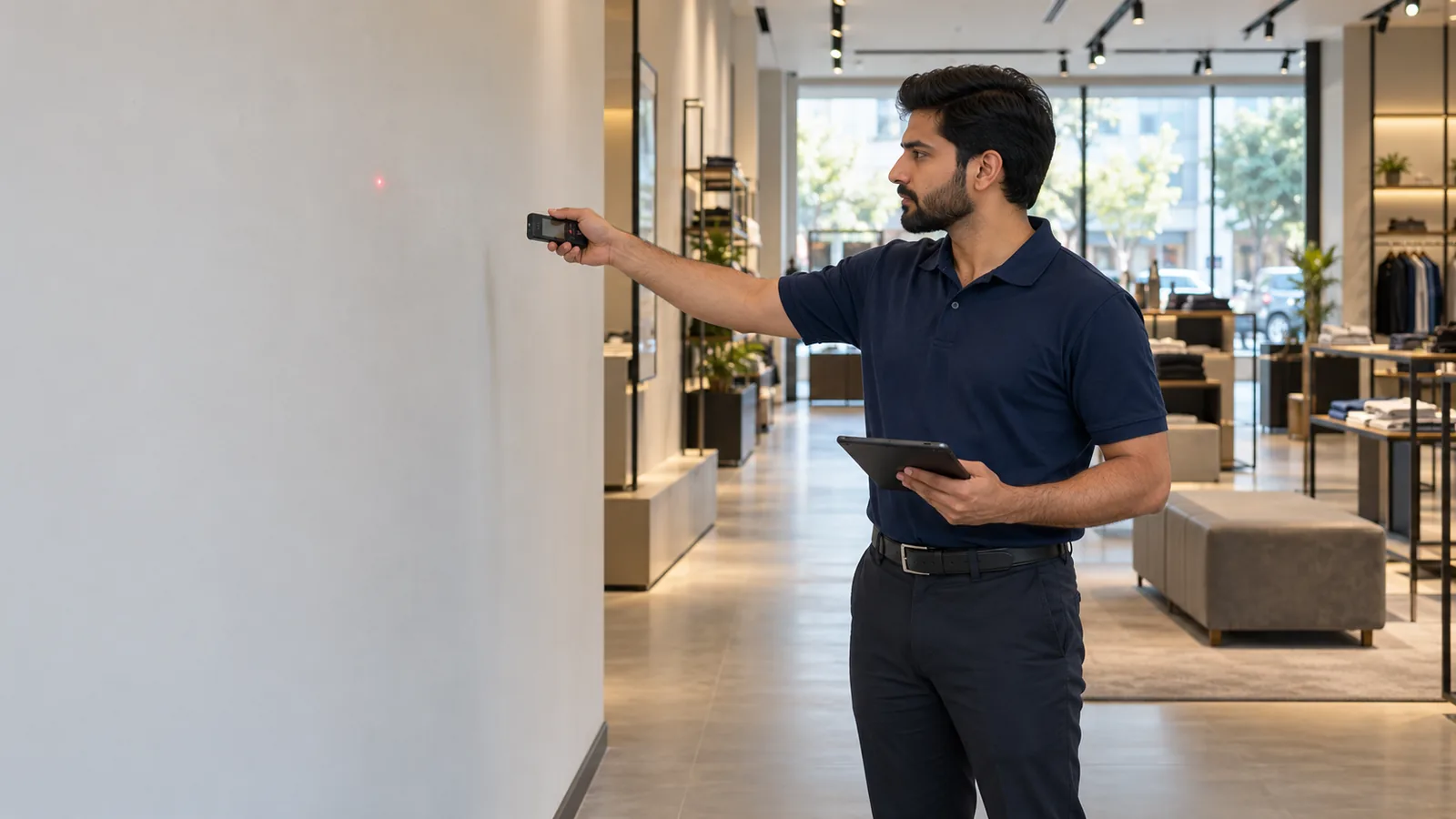
Send us these five things and you will have an itemised quotation, usually within one working day:
- Your city and the exact location (shop interior, shop front, rooftop, hall…).
- The wall or site size – width and height, roughly is fine.
- How close the nearest viewers will stand.
- Two or three photos of the site.
- What you will show – video adverts, menus, live feeds, text.
Send the details on WhatsApp or use the contact page. Our teams install and support SMD screens across Pakistan from Lahore, Karachi and Islamabad.
Looking for prices of standees, kiosks, video walls and menu boards too? See our digital signage price guide.
Why DIGIX
DIGIX is the digital wing of Adsells Advertising, in advertising since 1952, with more than 5,700 screens installed across Pakistan. We supply the screen, fabricate the structure, install, calibrate and support it with our own teams – and you can manage the content on one screen or every branch from the DIGIX CMS. See our work in the projects gallery.
SMD screen price – frequently asked questions
What is the price of an SMD screen per square foot in Pakistan?
In 2026, indoor SMD screens from DIGIX start price on request for P4 and go up to about price on request for fine-pitch P1.5. Outdoor screens start price on request for P10. These are screen-only rates; structure and installation add 10–15% and GST is extra.
How much does a 10 × 6 ft SMD screen cost?
A 60 sq ft indoor P2.5 screen costs about price on request for the screen, so roughly Rs 1.0–1.6 million for the screen plus 10–15% for the frame and installation, before GST. Use the DIGIX price calculator for your exact size.
Which pixel pitch is the cheapest?
The larger the pitch number, the cheaper the screen per square foot. P10 is the most economical outdoor pitch and P4 the most economical indoor pitch. Choose the largest pitch that still looks sharp from where your viewers stand.
Why is an outdoor SMD screen more expensive than an indoor one?
Outdoor screens need 5–7 times the brightness to be readable in sunlight, sealed IP65 modules against dust and rain, and a heavier steel structure. The DIGIX P5 and P8 outdoor modules deliver 7,000+ and 7,500+ nits.
Does the price include installation?
The per-sq-ft rates are for the screen only. Steel structure, frame and installation usually add 10–15% for normal walls, more for rooftops, poles or sites that need a crane. The DIGIX quotation lists these separately.
What is the price difference between SMD, GOB and COB?
For the same pitch, GOB costs about 30% more than standard SMD and COB about 60% more. GOB adds a protective glue layer; COB seals the chips for deeper blacks and a tougher surface. See our SMD vs GOB vs COB guide.
How much electricity does an SMD screen use?
Indoor screens use about 130–160 W per square metre on average. A 60 sq ft indoor screen running 12 hours a day uses roughly 250–350 units a month. Outdoor screens use more because they are brighter. Our SMD power calculator gives a figure for your size.
Can I get an SMD screen on instalments or rent?
DIGIX currently supplies screens on outright purchase. For events, our P3.9 outdoor cabinets are used by rental partners – ask us and we will connect you.
How long does an SMD screen last?
The LEDs are rated for about 100,000 hours. Real life depends on brightness settings, ventilation and running hours. DIGIX offers 1–5 years’ warranty depending on the product and supports every screen from Lahore, Karachi and Islamabad.