Key takeaways
- Digital menu boards have moved beyond slideshows: they now switch menus by time of day, show video, and connect to POS and stock systems.
- Short food videos, clear prices and one highlighted offer per screen help customers decide faster and notice higher-margin items.
- Self-ordering kiosks and countertop screens are becoming practical for cafés and smaller restaurants, not only large chains.
- The software matters as much as the screen: choose a CMS that lets you update every branch from one dashboard.
In this guide
- Video and motion menus
- Automatic menus by time of day
- POS and stock integration
- Smarter, personalised suggestions
- Self-ordering kiosks
- Touchless and QR interaction
- Clear dietary and allergen information
- Urdu and English menus
- Weather and event-based promotions
- Cloud CMS for multi-branch restaurants
- Frequently asked questions
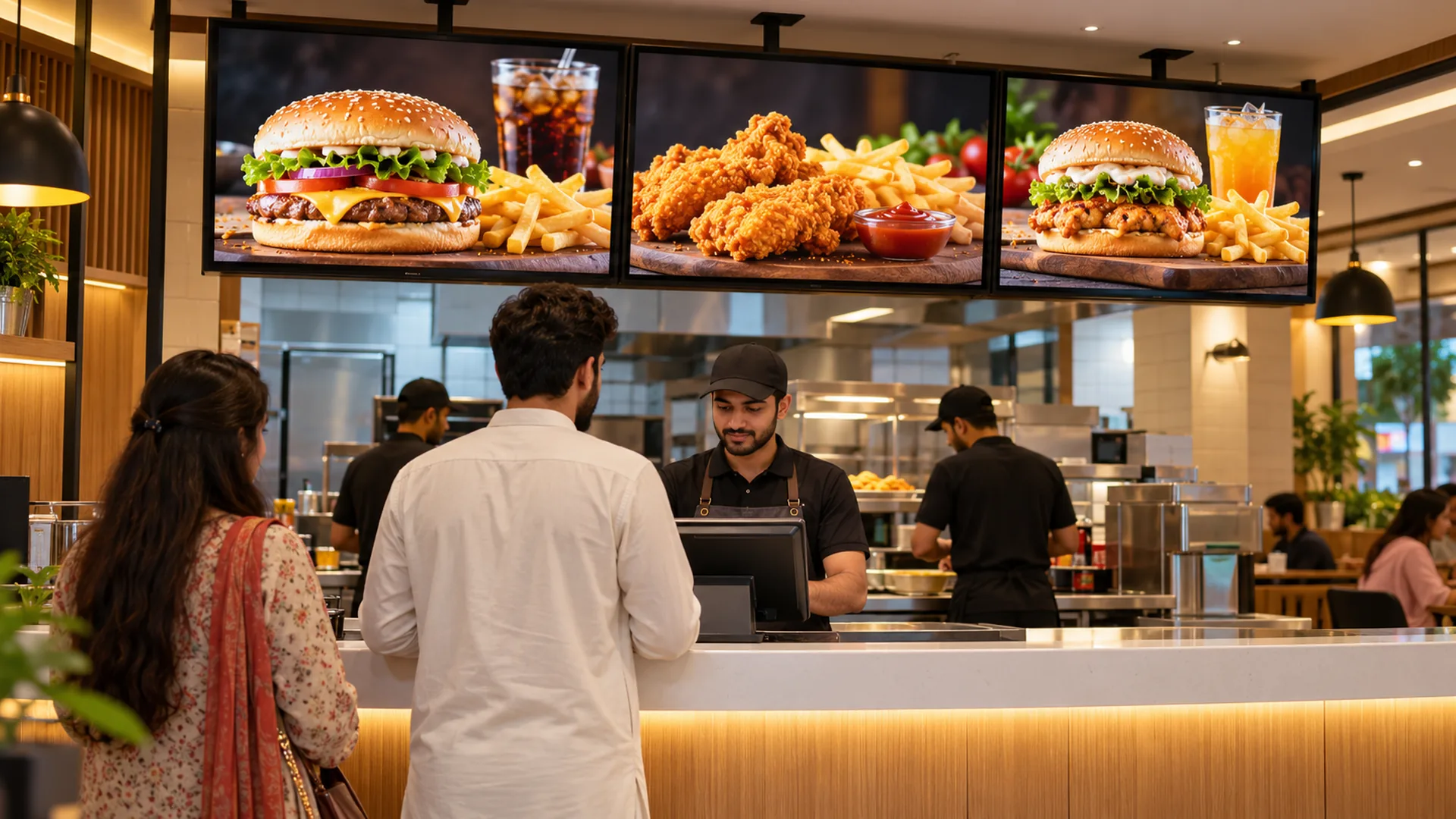
Walk into a modern restaurant, food court or café today and you will often see the printed menu replaced by bright digital screens. Digital menu boards help customers decide faster, help restaurants promote the right items at the right time, and remove the cost of reprinting menus every time a price changes.
The technology has matured. Today’s menu screens can switch automatically between breakfast and dinner, play short food videos, hide sold-out items and update every branch at once. This guide covers the digital menu screen trends restaurants are using in 2026, and how Pakistani restaurants can apply them.
1. Video and Motion Menus
Movement catches the eye. Steam rising from a karahi, cheese stretching from a pizza slice or a cold drink being poured makes food look fresh and appealing in a way a still photo cannot.
Short looping clips of around 6 to 15 seconds work best. Many restaurants combine them with subtle animation: prices that fade in, a pulsing “New” badge on a limited-time item, or a combo that slides into view.
Keep it balanced. Use motion to highlight one or two items per screen, and keep the rest of the menu calm and easy to read.
2. Automatic Menus by Time of Day
Dayparting means scheduling different menus for different hours. A café can show breakfast, parathas and chai in the morning, switch to lunch deals at noon, and move to family dinner combos in the evening, without anyone touching the screen.
The same scheduling handles Ramadan sehri and iftar menus, weekend deals and happy-hour drinks. Because changes happen automatically, there is no risk of the morning menu still showing at night.
3. POS and Stock Integration
A digital menu connected to your point-of-sale (POS) system can update itself. When an item is marked sold out at the counter, it can disappear from the screens or be replaced with an alternative.
For restaurant chains, price changes and new items can be pushed to every branch from one place, so customers see the same correct price everywhere.
Integration depends on your POS software, so confirm compatibility before choosing a system.
4. Smarter, Personalised Suggestions
Some advanced systems now adjust what they highlight based on time of day, current orders or loyalty data. For example, a returning loyalty customer might be shown a dessert they often order, or a family at the weekend might see family deals first.
For most restaurants in Pakistan, the practical starting point is simpler: plan which items to promote at which times, and use the screen to suggest an add-on such as a drink or dessert. If you consider camera-based audience analytics, make sure it is anonymous and that customers are informed.
5. Self-Ordering Kiosks
Self-ordering kiosks let customers browse the full menu, customise their order and pay at a touchscreen. They reduce queues at busy times and give customers time to explore, which often leads to add-ons.
Three improvements stand out:
- Helpful upselling: suggestions based on what is already in the order, such as a drink with a burger, rather than the same question for everyone.
- Loyalty and payment in one flow: customers scan a QR code, see their points and pay without switching screens.
- Smaller formats: countertop kiosks suit cafés and small restaurants with limited floor space.
6. Touchless and QR Interaction
Not every customer wants to touch a shared screen. QR codes on the menu board let customers open the menu on their own phone, see details and order from the table.
Voice ordering and gesture control are developing too, but QR-based ordering is the most practical touchless option for most restaurants today.
7. Clear Dietary and Allergen Information
Customers increasingly want to know what is in their food. Digital menus make it easy to show clear icons for spicy, vegetarian, contains nuts or contains dairy, and to update them when a recipe changes.
Keep this information visible and consistent, not hidden in small print. It builds trust and reduces questions at the counter.
8. Urdu and English Menus
Digital screens can show menus in both Urdu and English, alternate between them, or use one language on each screen. This helps restaurants in tourist areas, airports and large cities serve a wider range of customers.
Use large fonts, high contrast and consistent icons so the menu is readable from a distance and for customers with weaker eyesight.
9. Weather and Event-Based Promotions
What people want to eat changes with the weather. A connected menu can push soups and hot drinks on cold evenings and cold drinks and ice cream during a heatwave.
Events matter too. A cricket match, Eid, Independence Day or a nearby concert can trigger a pre-planned deal at the right time, so the promotion feels relevant rather than random.
10. Cloud CMS for Multi-Branch Restaurants
Behind every good menu screen is the content management system (CMS). Without one, a price change across several branches means emailing files to each manager and hoping they upload them correctly.
With a cloud CMS, the marketing team designs a promotion once, schedules it, and sends it to every screen in every branch, with a report showing which screens received it. Useful features include user permissions for branch managers, scheduled campaigns and a one-click override for urgent messages such as sold-out items or closures.
Before you buy menu screens, ask: which CMS do they run on, and does it work with your POS? The screen is only part of the system. Read more about the DIGIX CMS Player.
Getting Started
Start with a simple audit. What do your current menus show, how often do prices change, and how many steps does an update take? Then decide which trends matter most for your restaurant: dayparting and clear pricing for a café, video menus for a burger or pizza brand, or kiosks for a busy food-court outlet.
DIGIX supplies and installs digital menu boards, kiosks and CMS for restaurants across Lahore, Karachi, Islamabad, Gujranwala, Faisalabad, Multan and Rahim Yar Khan. You may also find our guide on why restaurants should avoid consumer TVs for digital menu boards useful.
Frequently Asked Questions
What is a digital menu board?
A digital menu board is a commercial display that shows your menu, prices and promotions, and can be updated from a computer or phone instead of being reprinted.
Can I change prices on all screens at once?
Yes. With a cloud CMS, you can update prices and items once and send the change to every screen in every branch.
Can digital menus change automatically between breakfast, lunch and dinner?
Yes. Menus can be scheduled by time and day, including special schedules for Ramadan, weekends and events.
Do I need a self-ordering kiosk as well as menu boards?
Not always. Menu boards suit most restaurants. Kiosks are most useful where queues are long or orders are often customised.
Can I use ordinary TVs as menu boards?
Consumer TVs are not designed for long daily operating hours and commercial use. Commercial displays are more reliable for restaurants.