Key takeaways
-
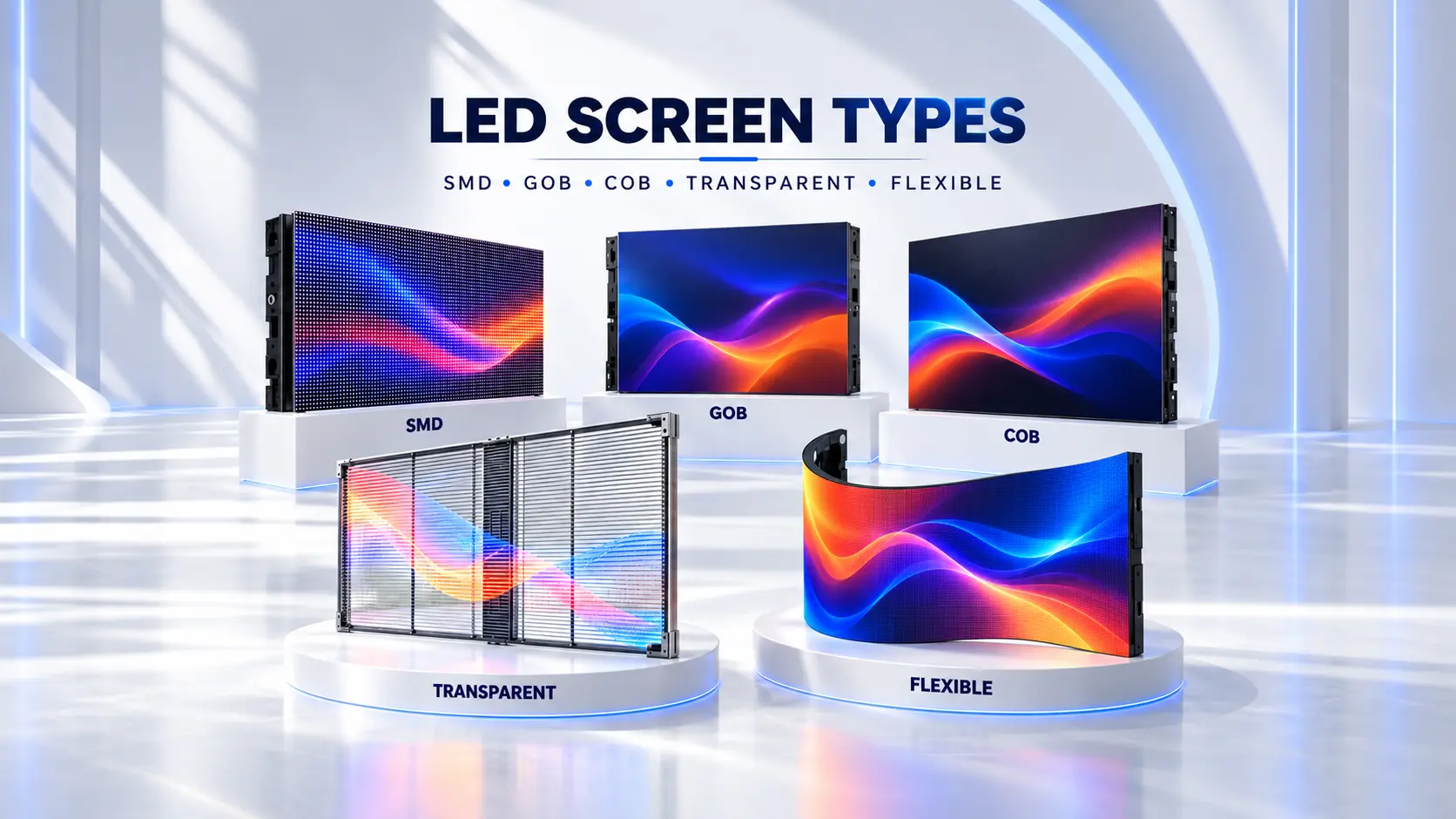
- SMD is the standard LED screen: the best value for most indoor and outdoor projects, from P1.5 to P10.
- GOB (Glue on Board) adds a clear protective layer over the LEDs. It resists knocks, dust and moisture and costs about 30% more than SMD.
- COB (Chip on Board) seals the LED chips inside the module. It gives the deepest blacks and is the toughest option for fine pitch (P0.9–P1.8). It costs about 60% more than SMD.
- Transparent and flexible LED screens are made for glass façades, curves and creative shapes.
🔍 Full interactive guide: SMD vs GOB vs COB vs LOB →
In this guide
“SMD screen” is what most people in Pakistan call any LED screen. But the way the LEDs are mounted and protected makes a big difference to how the screen looks up close, how long it lasts and what it costs.
This guide explains the main types of LED screens DIGIX supplies: SMD, GOB, COB, transparent and flexible. It shows where each one makes sense, so you only pay for what your project needs.
1. The Five Types at a Glance
| Type | How it is built | Best for | Typical pitch | Price vs SMD |
|---|---|---|---|---|
| SMD | Each LED is a small package soldered onto the board | Most indoor and outdoor screens | P1.5 – P10 | Base price |
| GOB | SMD with a clear glue layer poured over the LEDs | Malls, events, rental, screens people can touch | P1.5 – P4 | About +30% |
| COB | LED chips mounted directly on the board and sealed in one surface | Boardrooms, control rooms, studios, luxury retail | P0.9, P1.2, P1.5, P1.8 | About +60% |
| Transparent | LED strips with open gaps so you can see through the screen | Shop windows, glass façades, showrooms | Depends on model | On request |
| Flexible | Soft modules that bend | Pillars, curves, waves and creative shapes | Depends on model | On request |
Prices are a rough guide for the same size and pitch. Your exact price depends on brand, size, structure and site conditions.
2. SMD LED Screens
SMD stands for Surface Mounted Device. Each pixel is a tiny package with red, green and blue LEDs, soldered onto the module. It is the most common LED technology in the world and the default choice for most projects.
- Strengths: the best value for money, a wide choice of pixel pitches and easy repair, as single LEDs can be replaced.
- Watch out for: the LEDs stand slightly above the board, so a hard knock can break one off. Indoor SMD screens are not protected against water or heavy dust.
- Best for: lobbies, retail stores, restaurants, halls and almost all outdoor billboards.
Some modern SMD modules, such as the Unilumin LC1.839P, also come with a nano coating. This thin protective layer helps keep the LEDs from falling off without the cost of full GOB.
3. GOB LED Screens (Glue on Board)
A GOB screen starts as a normal SMD module. A layer of clear, hard glue is then poured over the whole LED surface and cured. The result looks like a smooth sheet of glass over the pixels.
- Strengths: it protects the LEDs from knocks, dust, moisture and static. It is safe to touch and easy to wipe clean, and the matte surface reduces glare.
- Watch out for: it costs about 30% more than SMD, and repairs are done module by module instead of LED by LED.
- Best for: screens at hand height in malls and shops, event and rental screens that are set up and taken down often, and dusty or busy places.
4. COB LED Screens (Chip on Board)
In a COB module there are no separate LED packages. The bare LED chips are mounted directly onto the circuit board and sealed together under one flat, matte surface. It is the newest technology and the best choice for fine-pitch screens viewed up close.
- Strengths: very high contrast, deep blacks and no reflections. It is very tough, as there are no LEDs to knock off, and it resists moisture and dust. It runs cooler and uses less power.
- Watch out for: it costs about 60% more than SMD and is mainly made in fine pitches.
- Popular pitches: P0.9, P1.2, P1.5 and P1.8.
- Best for: boardrooms, control rooms, TV studios, experience centres and luxury retail, where people stand close to the screen.
5. SMD vs COB: Real Datasheet Numbers
Here is how two indoor Unilumin modules of a similar pitch compare, taken from the manufacturer’s datasheets. Both use the standard 320 × 160 mm module size.
| Specification | SMD (nano coated), LC1.839P | COB, LC1.5 |
|---|---|---|
| Pixel pitch | 1.839 mm | 1.53 mm |
| Pixels per module | 174 × 87 (15,138) | 208 × 104 (21,632) |
| Brightness | 650 – 1,000 nits | 500 – 600 nits |
| Contrast ratio | 9,000:1 | 10,000:1 |
| Average power | 163 W/m² | 130 W/m² |
| Maximum power | 488 W/m² | 285 W/m² |
| Refresh rate | 3,840 Hz (7,680 Hz optional) | 3,840 Hz and above |
| Viewing angle | 160° / 160° | 160° / 160° |
| Surface | Nano coated LEDs | Sealed, matte, no reflection |
| Lifespan | 100,000 hours | 100,000 hours |
What this means: the COB module packs more pixels into the same module, gives deeper blacks and uses noticeably less power. The SMD module is brighter, which helps in bright, sunlit indoor spaces, and costs less.
Figures are the manufacturer’s reference values. Real results vary with configuration, content and environment.
6. Transparent and Flexible LED Screens
Transparent LED screens
Transparent screens are built from thin LED strips with gaps between them, so light and people’s view pass through. From outside, the content seems to float on the glass; from inside, the room stays bright and the view is not blocked.
- Best for: shop windows, glass building fronts, car showrooms and exhibition stands.
Flexible LED screens
Flexible modules use a soft base that bends, so the screen can wrap around round pillars or follow curves and waves.
- Best for: mall pillars, curved walls, ceilings and creative brand installations.
See flexible SMD walls in action in our projects gallery, for example the curved SMD walls at Ethnic’s Dolmen Mall flagship.
7. Which One Should You Choose?
| Your situation | Our usual advice |
|---|---|
| Lobby, store or restaurant, viewed from 3 m or more | SMD, P2.5 – P4 |
| Outdoor billboard or building façade | Outdoor SMD, P4 – P10 |
| Screen at hand height, or in a busy mall corridor | GOB |
| Event or rental screen, set up and moved often | GOB |
| Boardroom, control room or studio, viewed from 1–3 m | COB, P0.9 – P1.8 |
| Shop window or glass front | Transparent LED |
| Round pillar or curved wall | Flexible LED |
Not sure about size and pixel pitch? Start with our free planner. It suggests the right pitch for your viewing distance and gives a tentative price for a standard SMD screen.
[digix_planner_cta title=”Plan your screen size and pixel pitch” text=”Enter your wall size and viewing distance – get the right pixel pitch, resolution, power use and a tentative SMD price in 60 seconds.”]
For GOB, add about 30% to the SMD estimate; for COB, add about 60%. For transparent or flexible screens, ask our team for a quotation.
8. Frequently Asked Questions
What is the difference between SMD and COB?
In an SMD screen each LED is a separate package soldered onto the board. In a COB screen the bare LED chips are mounted directly on the board and sealed under one surface. COB gives deeper blacks, a tougher surface and lower power use, but costs about 60% more.
What does GOB mean in an LED screen?
GOB means Glue on Board. A clear protective glue layer is poured over a normal SMD module to protect the LEDs from knocks, dust and moisture.
Is GOB better than SMD?
GOB is more durable, so it is better where people can touch the screen or where it is moved often. For a screen mounted high on a wall, standard SMD gives the same picture for less money.
Is COB worth the extra cost?
Yes, when viewers stand close, as in boardrooms, control rooms and studios, or when you need fine pitch below P1.8. For screens viewed from a distance, SMD is the better value.
Which pixel pitches are available in COB?
The most popular COB pitches are P0.9, P1.2, P1.5 and P1.8.
Are GOB and COB screens waterproof?
They resist moisture and dust much better than indoor SMD, but indoor GOB and COB screens are still meant for indoor use. For outdoor screens choose a weatherproof outdoor model.
Does DIGIX supply all these types?
Yes. DIGIX supplies and installs SMD, GOB, COB, transparent and flexible LED screens across Pakistan, with offices in Lahore, Karachi and Islamabad.
Get the right screen for your project
Tell us where the screen will go, its size and how close people will stand. Our team will recommend the right type and send an itemised quotation.