Key takeaways
- Moving content catches the eye faster than a printed poster, which makes screens useful in busy malls, bazaars, banks and showrooms.
- The biggest gains come from strategy, not hardware: scheduling content by time of day, one clear offer per screen, and a call to action.
- Different spaces need different products, from standees at the entrance to menu boards, kiosks and outdoor SMD screens.
- Start small, measure results against your own sales data, and improve content every week.
In this guide
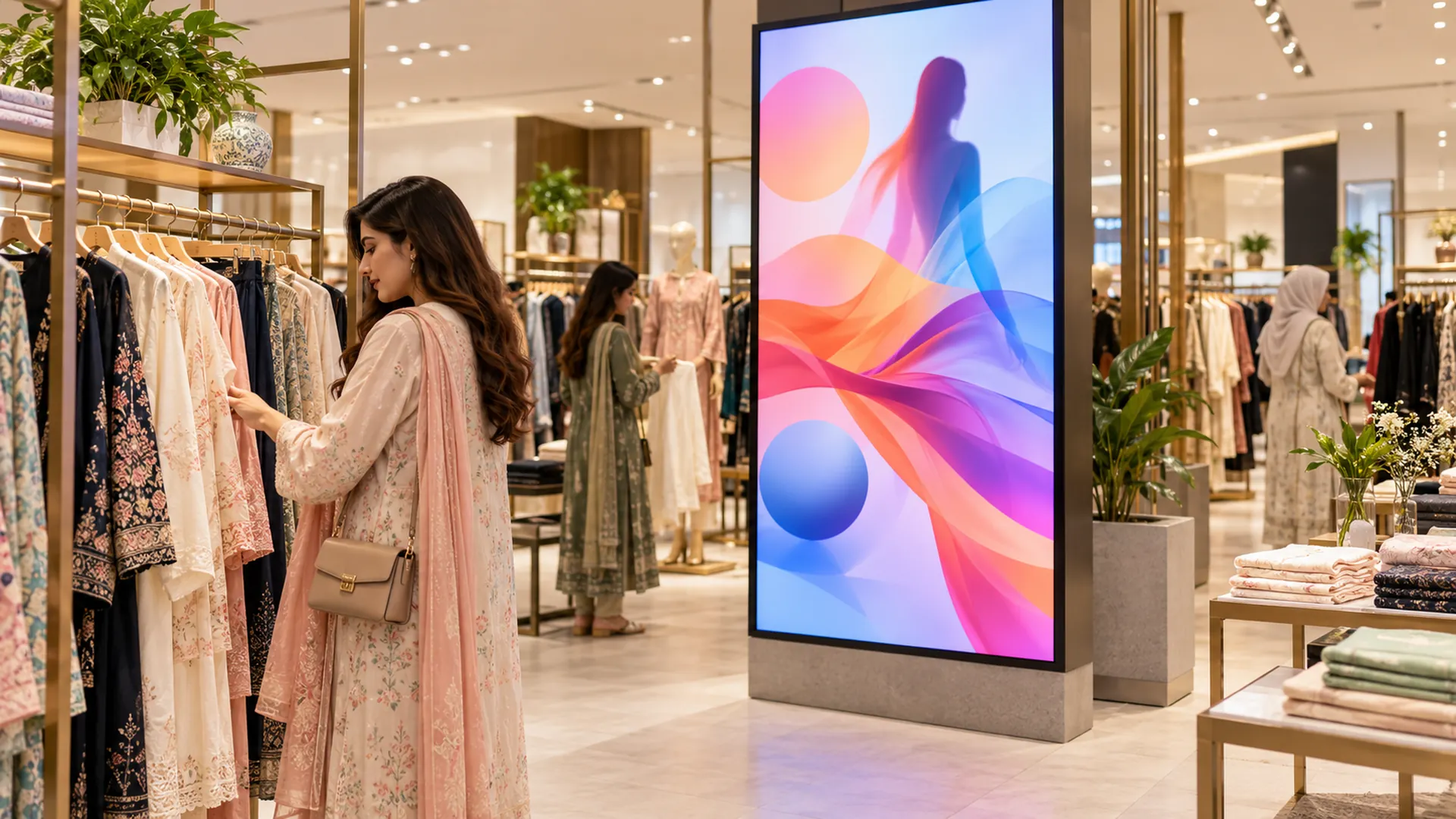
Picture a busy Saturday afternoon on Lahore’s MM Alam Road. Two clothing stores sit side by side with similar products and prices. One has digital standees running seasonal lookbooks, fabric close-ups and a countdown to an end-of-day sale. The other has a printed banner, faded from the last campaign.
Which store would you notice first?
Your display environment works like your first salesperson. It catches attention, communicates your offer and makes walking in feel easy, all before anyone says a word.
This is a practical guide for Pakistani business owners and marketing teams who want to use digital signage as a sales tool, not just as decoration.
1. Why Shoppers Respond to Screens
People notice movement before they read text. A screen playing video naturally draws the eye more than a static poster, however well designed. In a crowded mall in Karachi, a bazaar in Gujranwala or a bank branch in Islamabad, that extra moment of attention is valuable.
Pakistani shoppers are used to colourful, high-energy commercial spaces. A well-planned digital display fits naturally into that environment, while giving you precise control over what is shown and when.
Showing a product in use, rather than a still photo, also helps customers imagine owning it, which shortens the step from looking to buying.
2. 10 Ways to Use Digital Signage to Increase Sales
1. Match content to the time of day
Dayparting means scheduling different content for different hours automatically. A café in Islamabad’s F-7 can show chai and paratha deals in the morning, lunch combos at midday, snacks in the afternoon and family dinner deals in the evening, without anyone changing the screen by hand.
A fashion store can follow the same idea: new arrivals in the morning, lunchtime offers at midday, family offers after Asr, and a closing-time sale in the evening.
2. Create urgency with countdown timers
A live message such as “Flash sale ends in 2 hours” gives customers a reason to act now rather than later. Printed material cannot do this. Use countdowns only for genuine time-limited offers.
3. Show social proof at the point of decision
Screens can display customer reviews, Google ratings, social media posts and short testimonial videos. Seeing that other people chose you makes the decision easier for the next customer.
4. Make promotional pricing clear and visible
Show the original price, the offer price and when the offer ends, in large, high-contrast numbers. A clear discount on a familiar product is a strong reason to stop and look.
5. Cross-sell and upsell without extra staff
A small screen near the checkout of a mobile phone shop in Hafeez Centre can cycle through cases, screen protectors and accessories for the week’s best-selling handsets. The screen suggests; the staff complete the sale.
6. Build trust before the conversation starts
In banks, car showrooms, clinics and real-estate offices, customers form opinions while they wait. Screens in these spaces can explain products, show client stories and introduce your team, so the customer arrives at the desk already informed.
7. Run location-specific offers
With a central CMS, a chain can run one offer in Lahore and a different one in Karachi, tied to a local event, match or festival. Different branches can get different content from the same dashboard.
8. Turn waiting time into selling time
Bank queues, hospital waiting rooms, salons and restaurants all have customers with time to spare. A screen in these spaces has a relaxed, attentive audience. Use it to introduce services the customer may not know you offer.
9. Let customers explore on interactive screens
Touchscreen kiosks and standees let customers browse at their own pace. In a car showroom, a customer can choose colour, trim and accessories and see the result before speaking to a consultant, which makes the later conversation more focused.
10. Measure and improve
Digital signage is not set-and-forget. Compare content schedules with your own sales data by product, day, time and branch, then adjust. The DIGIX CMS provides playback and screen-status information to support this.
3. The Right Solution for Each Sales Environment
Different spaces need different products. This is how DIGIX solutions match common selling environments:
| Sales environment | Recommended solution | Sales goal |
|---|---|---|
| Store entrance or window | Digital standee | Draw passers-by inside |
| Restaurant or food court | Digital menu boards | Promote high-margin items and combos |
| Bank or clinic waiting area | Display screens with CMS | Introduce products during waiting time |
| Car showroom | Interactive touch kiosk | Let customers explore models and options |
| Mall or large store | Video wall or SMD screen | Strong brand presence |
| Petrol station forecourt | Outdoor high-brightness SMD screen | Promote the shop and services while customers refuel |
| Hotel lobby | Digital standee and wayfinding kiosk | Promote dining, services and events |
| Brand showroom or launch | Hologram fan display or large LED screen | Stand out and create a memorable experience |
| Supermarket shelves | Shelf-edge displays | Influence choice at the point of purchase |
4. Content That Sells
Hardware is the easy part. When screens disappoint, the content is usually the problem: too much text, too little movement and no clear next step.
Content rules for sales-driven screens
- Three-second rule: the main message should be clear within a few seconds.
- Motion first: start with movement that catches the eye, then show the message.
- One offer per screen: one clear offer works better than three competing ones.
- Always include a call to action: a price, a QR code, or a direction such as “Ask at the counter”.
- Make it local: use faces, places and occasions your customers recognise.
Plan a weekly content calendar
Plan screen content weekly, just like social media. For example, a Lahore retailer might show new arrivals early in the week, best-sellers midweek, pause heavy promotion during Juma prayers on Friday and return with a family offer afterwards, and run its strongest content on the weekend.
5. Cost and Return
Every business owner asks two questions: what will it cost, and what will I get back?
Cost depends on the number and size of screens, indoor or outdoor use, installation work and CMS needs. Returns come from two places:
- Savings: less spending on printing, transporting and replacing posters and banners for every campaign.
- Extra sales: better visibility of offers, upselling and faster campaign changes.
To estimate your own payback, add up what you currently spend on printed promotions each year, compare it with the quoted cost of the system, and then track sales on promoted products after installation.
6. 30-Day Implementation Plan
- Week 1 — Audit and define: walk through your customer-facing spaces and choose the two or three places where a screen would get the most attention. Decide the goal for each: footfall, upselling or information.
- Week 1 — Site survey: contact DIGIX on 0302-8421126 to arrange a site survey of mounting, power, lighting and screen specifications.
- Week 2 — Proposal and decision: review the recommended hardware and CMS, confirm the scope and timeline, and share your brand guidelines and product images.
- Week 3 — Installation: DIGIX installs the screens, cabling and media players. No in-house IT team is needed.
- Week 3 — CMS training: your team learns to upload content, set schedules and check screen status.
- Week 4 — Launch and improve: go live, compare sales on promoted items, and adjust content and timing.
Timelines depend on the project size and site conditions. DIGIX has teams in Lahore, Karachi, Islamabad, Gujranwala, Faisalabad, Multan and Rahim Yar Khan for surveys, installation and after-sales support.
7. Industry Playbooks
Banking and financial services
Many customers in Pakistan still visit branches in person. Waiting-area screens can introduce financing products, insurance, digital banking registration and Islamic banking information while customers wait.
Retail and fashion
A shopper decides in a few seconds whether to walk in. A standee in the window showing the current collection and a clear offer helps turn a passer-by into a visitor.
Food and beverage
Digital menu boards can highlight high-margin items, show combos with appealing visuals, and change prices and menus instantly, including by time of day.
Petrol station forecourts
Customers stay at the pump for a few minutes while refuelling. High-brightness outdoor screens on the canopy or pump islands can promote the convenience store, car care services and loyalty programmes.
8. Frequently Asked Questions
How does digital signage increase sales?
It catches attention, shows offers clearly, creates urgency with time-limited promotions, suggests add-on products and builds trust before a salesperson speaks.
What return can a retail business expect?
It depends on your current print spend, footfall and how well the content is planned. Compare yearly printing costs with the system cost, then track sales on promoted products after launch.
Which product is best for restaurants?
Digital menu boards. They allow time-of-day menus, highlighting of high-margin items and instant price updates.
Can I control screens remotely from any city?
Yes. With the DIGIX cloud CMS, you can update content from a phone, tablet or laptop and send it to one screen or a whole network.
How quickly can digital signage be installed?
For many projects, installation and training can be completed within a few weeks of the site survey. Larger or custom projects take longer.
Is digital signage only for large brands?
No. A single digital standee in a small shop can make a visible difference. DIGIX supplies solutions for single outlets as well as multi-branch networks.
What content should I show?
One clear offer per screen, strong visuals with motion, a specific call to action, and a schedule that matches what customers want at each time of day.
What makes DIGIX different?
DIGIX provides hardware, CMS, installation and local support from teams in seven cities, and has worked in digital signage since 2015 as part of the Adsells group, established in 1952.