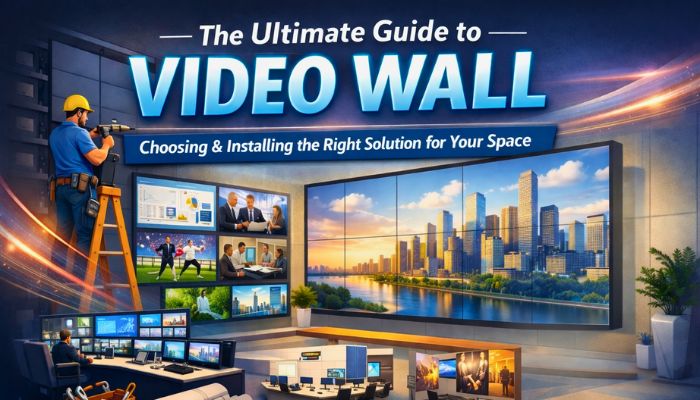
Walk into a modern airport, a high-end retail store, a corporate headquarters, or a live event venue — and the first thing that stops you in your tracks is usually the wall. Not just any wall. A wall that glows, moves, and commands attention. That is a video wall.
Video walls have quietly become one of the most powerful communication tools available to businesses, institutions, and brands worldwide. They are not just displays — they are experiences. And in a marketplace where grabbing and holding attention is harder than ever before, that distinction matters enormously.
This guide covers everything you need to know about video walls: how they work, which technology is right for your environment, how to plan and execute an installation, and why Pakistani businesses from Lahore to Karachi are increasingly choosing them as a cornerstone of their physical communication strategy.
| 400%
More attention than static signage |
$18B+
Global video wall market by 2028 |
24/7
Industrial-grade uptime capability |
0.9mm
Ultra-fine pixel pitch available |
1. What Is a Video Wall? — The Basics Explained
In the simplest terms, a video wall is a large display system made up of multiple screens — either LCD panels, LED modules, or rear-projection cubes — arranged in a grid and driven by a unified controller to show one single cohesive image, or multiple independent pieces of content simultaneously. Think of it as a canvas made out of screens.
Unlike a standalone television or a simple projector setup, a video wall is built for scale, durability, and continuous use. These systems are engineered to run 24 hours a day, 7 days a week, without suffering the image degradation or overheating problems that would destroy a consumer-grade display in a matter of weeks.
But a video wall is more than just a big screen. It is a communication platform. It tells stories, guides decisions, controls environments, and sells products — all at the same time. When a brand wants to make an entrance, when a control room needs to monitor multiple data feeds, or when a retail space wants to pull foot traffic in from the street, a video wall is the tool that delivers results nothing else can match.
| A video wall is not just a product. It is a strategic investment in how your brand looks, communicates, and performs in a physical space. |
2. How Video Walls Actually Work
Understanding a video wall means understanding three core components working together: the display panels, the processing hardware, and the content management system (CMS). Remove any one of these from the equation and what you have is either an expensive decoration or a frustrating mess.
The Display Panels
These are the physical screens that make up the wall. In LCD-based video walls, each panel is a thin display unit with ultra-narrow bezels — sometimes as slim as 1.7mm — so that the gap between screens almost disappears. In LED-based video walls, there are no individual screen borders at all. Instead, rows of tiny LED modules are tiled together to create a completely seamless surface of any shape or dimension.
The Video Wall Processor
This is the brain. A video wall processor takes content signals from multiple sources — computers, cameras, live feeds, streaming data — and distributes them precisely across every panel in the array. High-end processors can handle 4K and 8K content, manage dozens of input sources, and switch between layouts in real time without any visible lag.
The Content Management System
A powerful CMS ties everything together from a software perspective. It allows operators — whether they are a retail manager sitting in a back office or an IT administrator monitoring a control center — to schedule content, push updates remotely, divide the wall into custom layouts, and respond to triggers like time of day or audience data. The best CMS platforms are cloud-based, meaning the wall can be managed from anywhere in the world.
| A well-designed video wall system does not require a full-time AV technician standing over it. With the right CMS, a single person can schedule a week’s worth of content for multiple video walls across multiple locations — all in under an hour. |
3. Types of Video Wall Technology
Not all video walls are built the same. The right technology depends on your environment, viewing distance, budget, and goals. Here is a breakdown of the four main types currently dominating the market.
| Technology | Best For | Key Advantage | Consideration |
| LCD / LED-Backlit | Indoor retail, offices, control rooms | Cost-effective, easy to install | Visible bezel seams |
| Direct-View LED (SMD) | Large venues, flagship stores, outdoor | Fully seamless, any size or shape | Higher initial investment |
| OLED Video Wall | Premium retail, luxury brand spaces | Perfect blacks, ultra-thin profile | Very high cost, fragile |
| Rear-Projection Cube | Mission-critical control rooms | Extremely durable, 24/7 reliability | Deep installation footprint |
For most businesses in Pakistan and across South Asia, Direct-View LED video walls — also called SMD screens — have become the go-to choice. They offer the flexibility to go indoors or outdoors, the seamless visual experience that modern brands demand, and the durability to handle the heat and humidity that this region’s climate presents.
4. Industries That Use Video Walls
Video walls have found a place in virtually every sector of modern commerce and public life. Here is a look at the industries where they are making the biggest impact.
| Industry | Application |
| Retail & Shopping Malls | Entrance feature walls, brand storytelling, seasonal campaign displays, and wayfinding hubs that pull customers deeper into the store. |
| Corporate Offices | Lobby branding, boardroom data dashboards, and multi-department communication displays that reflect a company’s professional identity. |
| Control & Command Centers | Security monitoring, utility network management, traffic systems, and operations centers rely on high-reliability video wall systems. |
| Hospitality & Hotels | Grand lobby feature walls, event venue branding, and digital concierge information systems that elevate the guest experience. |
| Sports & Stadiums | Massive scoreboards, replay screens, crowd engagement displays, and sponsor content delivery at scale. |
| Education & Campuses | Lecture hall visual aids, collaborative learning environments, campus news feeds, and event promotion boards. |
| Healthcare & Hospitals | Patient wayfinding systems, waiting room information displays, and clinical data visualization tools. |
| Transport Hubs | Airports, railway stations, and bus terminals use video walls for schedule information, advertising, and passenger communication. |
5. Key Features to Look For Before You Buy
Buying a video wall is not like buying a television. There are dozens of technical specifications that will determine whether your investment delivers long-term results or becomes a maintenance headache. Here are the most important ones to understand.
Pixel Pitch
Pixel pitch is the distance between the center of one LED cluster and the next, measured in millimeters. A smaller pixel pitch means a higher pixel density, which means sharper images — but also a higher cost. For a control room where operators sit 2–3 meters from the screen, a 1.5mm or 2mm pitch is ideal. For an outdoor billboard viewed from 15 meters away, a 6mm or 10mm pitch is perfectly adequate and far more economical.
Brightness (Nits)
Indoor video walls typically need between 500 and 1,500 nits to look vivid in ambient lighting. Outdoor video walls, which must compete with direct sunlight, require anywhere from 4,000 to 10,000 nits or more. Underspecifying brightness is one of the most common and costliest mistakes buyers make.
Bezel Width
For LCD-based walls, the bezel gap between panels affects visual quality significantly. Premium narrow-bezel panels achieve as little as 1.7mm total gap width. If seamlessness is non-negotiable, Direct-View LED removes this issue entirely since there are no bezels at all.
Refresh Rate
For content that includes fast motion — sports footage, video ads, live feeds — a refresh rate of at least 3,840Hz is recommended to avoid flicker or banding, especially when the wall is being photographed or filmed.
IP Rating
For outdoor or semi-outdoor installations, the Ingress Protection (IP) rating tells you how well the hardware resists dust and water. A minimum of IP65 is standard for outdoor use in Pakistan’s varied climate conditions.
| Choosing the wrong spec for your environment is not a minor oversight — it is a decision that will cost more to fix than it would have cost to get right the first time. |
6. Video Wall vs. Single Large-Format Display
One question comes up in almost every client consultation: why not just buy one very large single screen instead of a multi-panel video wall? It is a fair question, and the answer depends entirely on the use case.
Single large-format displays — such as commercial monitors in the 75-inch to 110-inch range — are excellent for smaller spaces, meeting rooms, and menu board applications. They are straightforward to install, require less processing hardware, and have a lower upfront cost.
However, when you need to go beyond approximately 110 inches diagonally, cover an irregularly shaped wall, display multiple independent content zones simultaneously, or ensure sharp imagery at close viewing distances, a properly configured video wall becomes the only professional-grade option. A single 3×3 LCD video wall gives you the equivalent of a 180-inch display — something no single panel can match.
Beyond size, video walls offer one advantage that single screens simply cannot: redundancy. If one panel in a video wall fails, the system continues operating. If your single screen fails, the entire display goes dark.
7. Installation: What the Process Really Looks Like
First-time buyers are often surprised to learn that the installation of a video wall is as complex as the hardware itself. A professional installation is not just about mounting screens on a wall. It involves structural assessment, electrical planning, cable management, calibration, and commissioning — all of which must happen in the right sequence.
| # | Step | Description |
| 1 | Site Survey | A qualified AV engineer assesses load-bearing capacity, ambient light, power infrastructure, and cooling requirements. This is where problems are caught before they become costly mistakes. |
| 2 | Structural Mounting | Video walls are heavy. A 2×2 array of 55-inch panels can exceed 80 kg. The mounting frame must anchor to the building’s structural elements, not just the wall surface. |
| 3 | Cable Infrastructure | Power cables, signal cables (HDMI, DisplayPort, fiber), and network cables are routed cleanly. Poor cable management is the leading cause of long-term maintenance problems. |
| 4 | Display Calibration | Each panel is individually calibrated for color, brightness, and gamma to ensure the combined image appears uniform across the entire canvas. |
| 5 | Software Setup & Testing | The CMS and processor are configured, content templates loaded, and the entire system stress-tested for 24+ hours before client handover. |
The quality of installation has just as much impact on the end result as the quality of the hardware itself. A premium display poorly installed will never perform to its potential. This is why choosing an installation partner with both technical expertise and local service capability is not optional — it is essential.
8. Content Strategy for Maximum Impact
Here is something the hardware vendors rarely tell you: the best video wall in the world will fail if the content running on it is poorly designed. Visual technology is only as powerful as the message it carries.
Design for the Environment
Content that works on a phone or laptop screen rarely works on a video wall without adaptation. Text needs to be larger. Motion needs to be slower and more deliberate. Color contrast needs to be higher. If viewers are moving past the wall rather than standing in front of it, the key message must be communicated in under three seconds.
Use the Full Canvas
One of the most common content mistakes is treating a multi-panel video wall like a single large monitor. The real power of a video wall comes from using the full canvas creatively — splitting it into dynamic zones, using parallax effects, or running synchronized content across all panels for a cinematic full-screen impact during key moments.
Schedule Smartly
Dynamic scheduling allows content to change automatically based on time of day, day of the week, or even real-time data inputs. A retail video wall can show breakfast promotions at 8am, lunchtime offers at noon, and evening lifestyle content at 6pm — all without any manual intervention from your team.
9. Total Cost of Ownership
When evaluating the investment in a video wall, it is important to look beyond the purchase price and consider the total cost of ownership over a 5 to 7-year lifecycle. This includes installation, content creation, software licensing, maintenance contracts, and eventual component replacement.
Direct-View LED walls tend to have a higher initial cost than LCD arrays, but their lower maintenance requirements, longer panel life (typically 100,000 hours), and superior performance in challenging lighting conditions often make them the more economical choice over the long term. LED modules can be individually replaced without affecting the rest of the wall — a massive advantage over traditional display panels.
The smartest approach is to work with your installation partner to calculate a proper 5-year total cost of ownership before making a technology decision. The cheapest option at purchase is rarely the cheapest option over the lifetime of the system.
10. Why Businesses in Pakistan Are Investing in Video Walls
Pakistan’s commercial landscape is evolving at a remarkable pace. From Lahore’s Liberty Market to Karachi’s Dolmen Mall, from Islamabad’s Blue Area to the rapidly expanding retail corridors of Gujranwala and Faisalabad — brands are increasingly competing on the quality of their physical experience.
Pakistani consumers — particularly the growing urban middle class — have high expectations shaped by global retail and hospitality standards. A brand that looks great online but delivers a bland, outdated physical environment loses credibility the moment a customer walks through the door. Video walls are one of the most powerful tools available to close that gap.
Beyond retail, Pakistan’s expanding banking sector, telecommunications industry, petrochemical companies, and government institutions are all investing heavily in command and control infrastructure — and video walls are central to that infrastructure. Banks like HBL, Allied Bank, and Standard Chartered have already embraced high-quality display systems in their flagship branches and corporate offices.
The combination of rising commercial ambitions, growing digital infrastructure, and an increasingly sophisticated understanding of experiential marketing is creating exactly the conditions in which video wall adoption accelerates. The businesses that invest today will be the ones setting the standard others aspire to match tomorrow.
| Pakistan’s digital signage market is projected to grow significantly through the late 2020s, driven by infrastructure investment, retail modernisation, and an expanding middle class with higher expectations for commercial environments. |
11. How Digix Makes It All Happen
At Digix Digital, video walls are not just a product in a catalogue — they are a specialty backed by years of real-world deployment experience across Pakistan’s most demanding environments. From seamless SMD screen installations to custom-shaped LED builds for flagship retail spaces, Digix has delivered display systems that are still running, still performing, and still impressing — years after installation.
What makes Digix different from a generic hardware reseller is the end-to-end approach. The process starts with a consultation that is genuinely about understanding your space, your audience, and your goals — not just pushing you toward the most expensive option. It continues through site survey, structural assessment, hardware selection, custom fabrication where needed, professional installation by certified engineers, software configuration, staff training, and ongoing support.
Digix operates across six major cities — Lahore, Karachi, Islamabad, Gujranwala, Faisalabad, and Multan — with professional teams in each location. This is not a company that installs a system and disappears. When something needs attention, there is a local team available to respond quickly.
The client roster speaks to the trust that leading organisations place in Digix: Shell, Nestle, HBL, Standard Chartered, Toyota, Samsung, Unilever, Jazz, Telenor, KIA, Pizza Hut, and dozens more. These are not companies that make display technology decisions lightly. They chose Digix because the quality of the outcome — from the hardware to the installation to the ongoing service — consistently meets professional standards.
Whether you are a retail brand looking to make a statement, a corporate office building a world-class boardroom, or an institution that needs a reliable high-performance control room display system — Digix has both the products and the expertise to bring your vision to life.
12. Frequently Asked Questions
What is the minimum size for a video wall?
There is no strict minimum, but most video wall systems start at a 2×2 configuration (four panels). Below this, a single large-format commercial display is usually more practical and cost-effective. The sweet spot for most commercial installations in Pakistan tends to be 2×3 or 3×3 configurations, which deliver impressive visual scale without requiring significant structural modifications.
How long do video walls last?
Quality commercial-grade LCD panels are rated for 50,000 to 70,000 hours of continuous use. Direct-View LED modules are typically rated at 100,000 hours. At 12 hours per day of operation, a 100,000-hour rated LED wall has a theoretical lifespan of over 22 years. In practice, panels are often upgraded before they reach end of rated life because newer technology becomes available at compelling price points.
Can a video wall be used outdoors in Pakistan’s climate?
Absolutely — but the hardware must be specifically designed for outdoor use. Outdoor-rated Direct-View LED screens with IP65 or higher protection, high-brightness panels (5,000 to 10,000+ nits), and active cooling systems are essential for Pakistan’s summer temperatures and monsoon rainfall. Digix supplies and installs outdoor-grade display systems designed specifically for the South Asian climate.
How much does a video wall cost in Pakistan?
Pricing varies considerably based on technology type, size, pixel pitch, and installation complexity. A basic 2×2 LCD video wall for an office environment can start from a relatively modest investment, while a large-scale seamless LED installation for a flagship retail space represents a significantly higher commitment. Digix provides detailed, transparent quotations based on a proper site survey — there are no hidden costs or one-size-fits-all pricing lists.
What content formats do video walls support?
Modern video wall systems support virtually every standard content format: MP4 and other video formats, JPEG and PNG images, live HDMI and DVI feeds, web-based content, data dashboards, and streaming video. The Digix CMS platform is designed for flexibility — content can be scheduled, updated remotely, and organised into custom layouts for different zones of the wall.
Do I need a dedicated person to manage video wall content?
Not necessarily. With a well-configured CMS and properly scheduled content, a video wall can operate largely autonomously. Most clients designate one team member — often a marketing or communications person — who spends a few hours per week managing content. Digix provides comprehensive training and ongoing support to ensure your team feels confident running the system independently.
| Ready to Transform Your Space with a Video Wall?
Talk to the Digix team today. We will assess your environment, recommend the right solution, and provide a transparent quote — no pressure, no jargon. Contact Digix: 0302-8421126 | digixdigital.biz |
| Written by: Digix Team
Digital signage specialists serving Pakistan since 2015. Nationwide coverage across Lahore, Karachi, Islamabad, Gujranwala, Faisalabad & Multan. |