Introduction
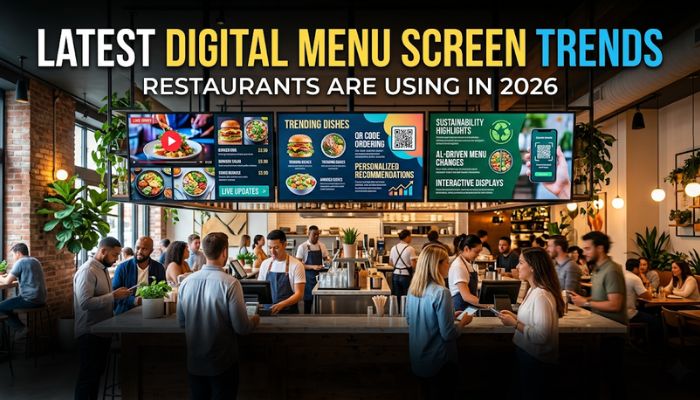
Walk into almost any modern restaurant today and you will immediately notice something different from a decade ago — the static laminated menu is gone. In its place, vibrant, animated, data-driven digital screens are reshaping how restaurants present their food and how customers decide what to order.
Digital menu boards have been around for a while, but 2026 is the year they have truly grown up. We are no longer talking about a simple slideshow of images swapping on a loop. Today’s restaurant digital screens are intelligent, interactive, and deeply connected to the rest of a restaurant’s operations — from the POS system to the kitchen display to the loyalty app on a customer’s phone.
Whether you run a quick-service burger joint, an upscale fine-dining establishment, or a ghost kitchen serving an entire city, digital menu technology is evolving fast. Staying ahead of it is no longer optional — it is a survival strategy. This article breaks down the most important digital menu screen trends of 2026, why they matter, and how you can use them to grow your restaurant business.
AI-Powered Personalization: Menus That Know Your Customer
Artificial intelligence has been creeping into restaurant technology for years, but in 2026, it has arrived at the menu board itself. The biggest shift we are seeing is the move from static, one-size-fits-all displays to AI-driven screens that adapt what they show based on who is watching — and when.
Here is how it works in practice: a camera mounted near the digital menu screen uses anonymous demographic analysis — no facial recognition, just general visual signals like approximate age group, group size, and time of visit — to tailor which items and promotions appear most prominently. A family with young children late on a Saturday afternoon might see the kids’ meal deals front and center. A lone adult ordering at 7 AM gets pushed toward premium coffee combinations and breakfast wraps.
Beyond camera-based cues, AI personalization also pulls from transactional data. If a restaurant chain’s loyalty programme identifies that a returning customer frequently orders spicy dishes, the system can highlight the spiciest new additions on the digital board near their preferred location. Brands like McDonald’s — through their acquisition of Dynamic Yield — and several independent cloud signage platforms have been rolling out exactly this type of capability throughout 2025 and 2026.
| WHY IT MATTERS FOR YOUR RESTAURANT
Personalized menu suggestions increase average check value. When a digital board shows the right item at the right moment, customers are significantly more likely to add on a dessert, upgrade their drink, or try a new featured item — all without any staff involvement. It is passive upselling done intelligently. |
For restaurant operators thinking about implementing AI personalization, the good news is that you do not need to be a global chain to access this technology. A growing number of SaaS platforms now offer AI menu personalization features at mid-market price points, often integrating directly with your existing POS and loyalty data. The investment pays back quickly through measurable gains in average order value.
Motion Graphics & Cinematic Video Menus: Food That Looks Irresistible
Static food photography still has its place, but in 2026 the restaurants that stand out are those using full-motion video and micro-animation on their digital menu screens. The logic is simple and deeply human: movement attracts attention, and when we see steam rising from a bowl of ramen or cheese melting over a fresh burger, our brains respond with genuine appetite cues.
What has changed in 2026 is how accessible and affordable high-quality food videography has become. With compact, high-resolution food camera setups now costing a fraction of what professional production required even three years ago, even independent restaurants and small chains are investing in short looping food clips — typically 6 to 15 seconds — designed specifically for digital menu boards.
Motion graphic design has evolved alongside this. Rather than just swapping a photo for a video, leading restaurant design agencies now create fully animated menu layouts where prices float in elegantly, dish names animate in with purpose, and limited-time offer badges pulse subtly to attract the eye without feeling garish. The result is a menu board that feels alive — premium, confident, and appetising.
“A menu board that moves sells more than one that stands still. Motion tells the customer that your food is fresh, your brand is modern, and that you care about the details — all in under five seconds.”
— Restaurant Design Consultant, 2026 Food Tech Summit
Restaurants adopting this trend are also smarter about content scheduling. The motion-rich, video-heavy version of the menu plays during peak hours when foot traffic is high and attention is fleeting. During slower periods, a quieter, more editorial layout with beautiful still photography takes over — keeping the ambiance right while still looking polished and professional.
Real-Time Dynamic Pricing & Time-Based Menu Scheduling
One of the most commercially powerful trends in digital menu screens in 2026 is dynamic pricing and automated time-based menu switching. If you have ever looked at a blank space on a digital board where a sold-out item used to be, or walked into a restaurant and noticed happy hour prices already showing without any staff having manually changed anything — you have already seen this in action.
In 2026, real-time menu management is standard practice for any restaurant running a proper digital signage system. Here is what that looks like operationally:
- Automated daypart switching: Breakfast boards switch to lunch menus at exactly 10:30 AM without any manual input. Happy hour deals appear at the right time every day — no human error, no forgetting to swap.
- Inventory-connected pricing: When a dish runs low, the system can automatically reduce its prominence on the digital board, surface alternatives, or alert kitchen staff. Advanced systems can price-down near-expiry specials automatically to reduce food waste.
- Demand-based pricing: Inspired by airline and ride-sharing models, some QSR chains are experimenting with slightly higher prices during peak demand windows — automatically applied through the digital board with full transparency to the customer.
- Event and occasion-triggered content: Public holidays, local sports events, and even the weather outside can trigger pre-planned promotional content automatically — no marketing manager needing to log in at midnight.
The dynamic pricing element remains the most debated aspect of this trend. Restaurants that are succeeding with it in 2026 position it as a ‘value reward’ during off-peak periods rather than as a penalty at busy times — building consumer goodwill alongside commercial results.
Touchless & Voice-Activated Menu Interaction
The COVID-19 pandemic accelerated interest in touchless technology, but that interest did not fade when the pandemic did — it evolved. In 2026, touchless digital menu interaction has matured from a hygiene-driven necessity into a genuinely preferred user experience option for many customers.
Voice-activated ordering kiosks are the most talked-about development in this space. Powered by large language model AI — the same family of technology behind conversational AI tools — these systems can now hold remarkably natural conversations with customers. They understand accents, handle complex customisations, and suggest alternatives when a preferred item is unavailable. Early deployments in fast-casual chains across the US and Europe have shown significant reductions in order errors compared to traditional touch-screen kiosks.
Gesture-based menu navigation is another area that has moved from experimental to practical in 2026. Using sensor arrays mounted above or beside large format screens, customers can swipe through menu categories with a wave of the hand — no touching required. This technology works well in high-volume environments like food courts and airport terminals where both hygiene and throughput are critical.
| ACCESSIBILITY ADVANTAGE
Voice and gesture interaction are not just about hygiene or novelty — they are genuinely more accessible for customers with mobility impairments, visual difficulties, or conditions that make traditional touchscreen use challenging. Restaurants that invest in these technologies are quietly building a more inclusive dining experience, which increasingly matters to today’s customer. |
Deep POS & Kitchen Display Integration
A digital menu board that is not connected to the rest of your restaurant’s technology stack is little more than an expensive picture frame. In 2026, the defining characteristic of a truly modern digital menu system is how deeply it integrates with point-of-sale, kitchen display systems, and inventory management.
When a bartender marks a cocktail as sold out on the POS, that item disappears from every digital menu board in the venue — instantly, automatically, with no duplicate work required. When the kitchen display shows a backlog building on a particular station, the digital menu can be configured to quietly reduce the visual prominence of that station’s items, subtly steering customers toward options with shorter wait times.
For multi-location restaurant groups, cloud-connected POS and menu integration also means that corporate-level menu changes — new items, price updates, allergen information revisions — can be pushed to every screen in every location simultaneously, from a single dashboard. In an era of tight food cost management and rapid consumer preference shifts, that speed and control is invaluable.
Sustainability Messaging & Eco-Conscious Menu Design
Consumer expectations around sustainability have reached a tipping point. In 2026, it is no longer enough for a restaurant to quietly use sustainable packaging or source locally — customers want to see that commitment reflected visibly in the brand experience, and the digital menu board is prime real estate for doing exactly that.
Restaurants are now designing their digital menu screens to prominently display carbon footprint estimates per dish, local sourcing badges, seasonal ingredient highlights, and plant-based alternatives — not buried in small print, but built into the visual design of the menu itself. Some platforms now integrate with food sustainability databases to display real-time carbon scoring alongside prices, giving eco-conscious customers genuine data to make decisions with.
Beyond just displaying information, smart restaurants are also using digital menus to actively steer customer choices toward lower-impact options through intelligent visual design — placing plant-based dishes in premium screen positions, using warm and natural visual treatments for sustainable choices, and featuring animated ‘today’s local harvest’ sections that change based on what is in season.
WHAT’S WORKING
|
COMMON MISTAKES
|
Multilingual & Accessibility-First Screen Design
The restaurant industry has always served a beautifully diverse clientele, but digital menu technology in 2026 is finally giving restaurateurs proper tools to reflect that diversity in their customer-facing experience. Multilingual digital menus — screens that automatically switch language based on the detected language preference of a signed-in loyalty member, or offer a language selection touchpoint — are becoming standard in cosmopolitan city markets.
Beyond language, accessibility-first screen design is having a meaningful moment. This means larger default font sizes, high-contrast display modes that can be activated via simple gestures, screen reader-compatible kiosk interfaces, and allergen information that is impossible to miss — not tucked away but displayed prominently with consistent iconography that transcends language barriers entirely.
For restaurants operating in tourist-heavy areas, airports, or major city centres, the ability to serve a menu in six languages simultaneously — each version optimised for that language’s typographic conventions — is not a luxury, it is a customer experience necessity. The digital menu technology of 2026 makes this not just possible but operationally straightforward.
Hyperlocal & Weather-Triggered Menu Content
One of the most quietly clever trends in restaurant digital menu screens is the integration of live external data feeds to make menu content feel genuinely relevant to the moment. Weather-responsive menus are the clearest example — and they work because what people feel like eating is deeply influenced by the conditions outside.
A café running a weather-connected digital menu might automatically push hot chocolate, soups, and warming spice dishes to the top of its board when the temperature drops below 10°C. The same system shifts to promote fresh salads, cold brew coffees, and fruit-based drinks when a heatwave hits. No manual intervention needed — the content is pre-built for each weather state, and the live weather API does the rest.
Hyperlocal content goes beyond weather. Local event triggers — a football match starting in two hours, a major concert nearby, a school term ending — can all be programmed into digital menu content calendars to serve highly relevant, timely promotions. A sports bar showing a food-and-drinks deal timed to the pre-match rush feels like great service rather than advertising.
The New Generation of Self-Order Kiosk Screens
Self-order kiosks are not new, but the 2026 versions are dramatically smarter and more commercially effective than their predecessors. Three major evolution areas are defining the new kiosk generation.
Upsell Intelligence That Feels Natural
Early self-order kiosks were blunt instruments — they asked every single customer if they wanted to upsize their fries regardless of what was being ordered. Modern AI-powered kiosk screens in 2026 make upsell suggestions that feel genuinely helpful rather than pushy. They consider the full order context, time of day, current inventory, and even previous customer order history before suggesting additions. The result is significantly higher add-on attachment rates with measurably better customer satisfaction scores.
Unified Loyalty & Payment Integration
The friction between self-ordering and reward redemption has been a longstanding frustration. In 2026, kiosk screens that deeply integrate with mobile loyalty apps — allowing customers to log in via QR code, see their points, apply rewards, and pay in a single seamless flow — have become a genuine competitive differentiator. Restaurants that have invested in this integration report loyalty programme engagement rates two to three times higher than those using separate kiosk and app systems.
Compact & Counter-Top Form Factors
The towering freestanding kiosk still has its place in high-volume QSR environments, but 2026 has seen significant growth in counter-top kiosk screens designed for smaller restaurants, cafés, and bars where floor space is precious. These compact units deliver the same self-order intelligence in a form factor that sits naturally on a service counter.
Cloud-Based CMS & Remote Multi-Site Management
Behind all of the visible consumer-facing trends sits a critical enabling technology: the cloud-based content management system that allows restaurant operators to control every digital screen, in every location, from a single web dashboard. In 2026, this infrastructure layer has become both more powerful and more accessible — fundamentally changing how restaurant marketing and operations teams work.
Consider what used to be involved in running a price promotion across 50 restaurant locations. The marketing team would design the artwork, convert it into the right file formats for each screen brand in each location, email it to every site manager, and then hope that every manager uploaded it correctly before the promotion start date. Errors and inconsistencies were constant.
With a modern cloud CMS built for restaurant digital signage, that same promotion is built once in a web-based design tool, scheduled to go live at an exact date and time, and pushed automatically to every screen in every location — with verification reports showing exactly which screens received the content and when.
The 2026 additions to cloud CMS technology most worth knowing about include granular user permissions so regional managers can customise their zone’s content within brand guardrails, built-in analytics dashboards correlating menu item screen impressions with sales data, and one-click emergency content override — critical for communicating sudden closures, safety alerts, or sold-out items restaurant-wide in real time.
| KEY QUESTION FOR OPERATORS
Before investing in any digital menu screen hardware, the most important question is: what CMS does it run on, and how deeply does that CMS integrate with my existing POS, inventory, and loyalty platforms? The screen is just a screen — the software behind it is where the real value lives. |
The Digital Menu Is Now Your Most Powerful Marketing Channel
Looking across all ten of these trends, a clear picture emerges: the digital menu screen in 2026 is no longer just a way to display prices. It is a real-time marketing channel, a customer experience tool, an operational efficiency engine, and a data collection asset — all at once.
The restaurants winning with digital menus in 2026 are not necessarily those with the biggest screens or the biggest budgets. They are the ones who have thought carefully about what each customer touchpoint in their venue is trying to achieve, and then equipped their digital menu technology to serve that purpose intelligently.
Whether that means investing in AI personalisation for a high-volume QSR environment, building motion-rich boards for a premium dining establishment, or simply ensuring that a small independent café’s digital board is connected to the weather so it automatically promotes warming drinks on cold days — the principle is the same: use the technology with intention, keep the customer experience at the centre, and the commercial results will follow.
If you are evaluating your restaurant’s digital signage strategy right now, the best starting point is a content and connectivity audit: what are your current screens showing, how current is that content, and how many manual steps does it take to update it? The gap between your answer and what the best systems in 2026 can deliver will tell you exactly where to focus your investment.
The future of the restaurant menu is not printed, not static, and not generic. It is digital, dynamic, intelligent — and it is already here.
| Ready to Upgrade Your Restaurant’s Digital Menu?
DigiX Digital specialises in digital signage strategy, content design, and CMS setup for restaurants of all sizes. Let’s build a menu experience your customers will never forget. Visit: digixdigital.biz/contact | Call: 0302-8421126 |